
 Jean Bernard Bruneteaux is a human resources (HR) expert. He held the HR function for 30 years, including 22 years as a director. One of the founders and member of the Institut Afrique Monde (IAM), he defends African culture and promotes a self-managed Africa for itself. By teaching and writing a book on human resources management and communication, he wishes to contribute his contribution and expertise to HR management in Africa. His book, in French and English, is the first book published by the IAM Editions.
The result of experiences and operational practices, Jean Bernard Bruneteaux’s book offers us a general and complete overview of the human resources and communication function and their management. It sets out the principles and presents the working methods and tools, clarified by theories and case studies.
Jean Bernard Bruneteaux’s book is a work of principles and processes on the human resources and communication function.
In modern companies, the HR function plays an important and increasingly strategic role. It must have a predominant place in the company, because it directly affects the purpose of the company.
In the eyes of the author, the purpose of the company must be people. Performance is the means. The latter depends in fine not on material resources, but on human resources. “What makes the difference between a desert and a garden is not the water but the man“, says an Arab proverb, quoted by Jean Bernard Bruneteaux.
At the same time, the search for economic performance of the company should not be carried out without taking into account the parameters of social and environmental responsibilities of the company.
In order for the company to be able to cope with the speed and complexity of economic, social, technological and political change, both nationally and internationally, the HR function must be attached to general management in order to be able to participate upstream in the development of the company’s strategy.
The essential task of the HR function is to place the right person in the right place at the right time and to accompany him or her throughout their career in the company. This requires the HR function to have a good knowledge of people and the company, and to find the right combination between them through good internal communication.
The HR function is a discipline that also requires knowledge of law, sociology, psychology, management and culture.
Culture marks the particularity of an individual, a company, a country. It is an element that must be increasingly taken into consideration when the HR function makes decisions.
The HR function requires professionalism.
Jean Bernard Bruneteaux’s book is also a book of tools and methods in human resources management and communication.
Professionalism implies following, in each field, at each level, in each action, well determined processes, well established protocols and rigorous, experienced and universally recognized tools and work methods, in order to reach the goal in an objective, reasonable and efficient way.
In Jean Bernard Bruneteaux’s book, the processes, protocols, tools and methods in human resources management and communication are approached around the three areas of the HR function: Organization, People and Management.
Organization
Regarding the organization, the author uses the image of the human body which is composed of living cells, linked together and interdependent, these are the jobs and workstations. Each cell has its role and responsibilities. They must adapt to the circumstances. Some may disappear while others are created.
There are different models in horizontal, vertical, pyramidal, matrix organization… The choice must be made according to the activity and the culture of the company.
Man
He is the one who animates the cells. He is responsible for them and develops them by his own energy. Hence the importance of recruitment, training, performance evaluation, remuneration and good communication with the other cells.
Numerous management tools and methods exist and serve to make the assessment of the man in relation to the responsibility he has to assume objective and efficient.
The rapid change, the uncertainty of the economic situation and the complexity faced by today’s company require not only “know-how” and “knowing how to behave”, but also “knowing how to adapt”. He must be reactive in order to meet the company’s requirements. The author distinguishes between the acquisition of knowledge, experience and competence (one can have a lot of experience but no longer be competent if one cannot adapt to new circumstances). This is the question of “employability”.
Management
In the cell organization, the manager’s role is to motivate his teams, to supervise their energies and to lead them towards a common goal. He must provide them with the best working conditions while knowing how to manage possible conflicts and negotiate with the unions.
Motivation consists in encouraging people to act on their own by exploring their own inner energy. The HR function must help people to manage economic change and not to undergo it. This requires the manager to have a deep knowledge of his teams: their own skills, culture, needs.
The development of modern technology is considerably changing the relationship between the hierarchy and its employees, and between colleagues themselves. In this new relational context, the authority of competence takes precedence over the hierarchical authority with more individual responsibility. The most appropriate management style is participative management. It allows the development of initiative, encourages innovation, creativity and personal and collective development. It is a management style that involves the most humanism and efficiency.
Among the different management techniques such as teamwork, meetings, coaching, and decision-making, the author insists on the notions of delegation, subsidiarity and trust, each with its own definition, which allow for participative management.
Jean Bernard Bruneteaux’s book is a book for Africa, but not only…
If the principles and methods of management are universal, their applications cannot be. They must take into consideration the particularities of each company, each country, each continent.
In human resources management, two essential characteristics differ from one country to another: legal regulations in labor law and cultures. The difference could create conflict but also complementarity.
From his experiences in Africa and his knowledge of this continent, Jean Bernard Bruneteaux notes that African cultural, ethical and moral approaches have very specific characteristics. The role of the ancestors, the authority of the chief, the notion of trust (which can sometimes take the form of submission), the notion of family, the community aspect (which can also be a brake on individual initiative), the relationship to time, the perception of work, the attitude towards money, etc. are relatively different from those of other continents. These differences can have an impact on the behavior of African employees in the company. Therefore, these particular and specific approaches, insists Jean Bernard Bruneteaux, must absolutely be taken into account for every aspect of HR management. As a result, HR management cannot be presented in the same way everywhere in the world.
But does this African diversity mean that Africa has its own management model? Can it operate outside of universal rules? Can the criterion of recruitment by personal, family or ethnic relationship or dependence override the criteria of knowledge, experience and competence required for a position? Can the authority of the leader be at the expense of autonomy, initiative and the development of personal responsibility?
Jean Bernard Bruneteaux invites us to reflect on these questions. For him, if Africa wants to be professional in human resources management, it must appropriate the existing models and methods, universally recognized and practiced, and consider its specificities and diversities not as an exception to these rules but as a complement to universality.
By dealing in detail with each aspect of the human resources and communication function, and by demonstrating the different ways in which they can be managed, Jean Bernard Bruneteaux’s book is a tool to be used to professionalize and perfect the HR and communication function. The principles, methods and trends presented in this book are valid not only for Africans, but also for Europeans, Asians, Americans… and for all those who want to know, practice and manage this function.
Hongbing Yang and Lyna Laure Amana
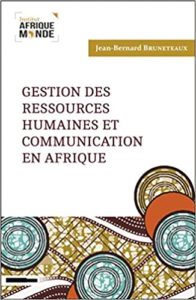
This note of reading concerns the book whose author is Jean Bernard Bruneteaux. The title of the book in French ” Gestion des ressources humaines et communication en Afrique ” (357 pages) and in English ” Human Resource Management and Communication in Africa “) (357 pages). Published in 2019 by IAM Editions, at a price of 25€ for each edition. Available at Amazon, FNAC.com, Les éditions du NET or directly from the Institut Afrique Monde (IAM, 42 rue de Grenelle 75007 Paris)